It’s not that I do not love Cairo. I do want to. And in part I do. But the experience of a relatively innocent and entirely unprepared soul arriving at Cairo Airport in the small hours of the morning does exact its toll, and may promote emotions other than, and contrary to, love .
The Egyptians are fond of procedures, the purpose of which seem, at times, both opaque and arbitrary. The indignities a visitors will be subjected to upon arrival are as numerous as they are diverse.
Immediately after disembarking, a large bushy mustache, attached to a brusque-looking little human, demanded to know if I really intended for Cairo to be my final destination – or if it wouldn’t, perhaps, be better if I went somewhere else.
My verbal assurance that Cairo was, indeed, where I wanted to go, was waved aside as inconsequential, and the Mustache proceeded to demanded that I produce my boarding card. This was a document that at this stage of my journey was long forgotten, and I had to rummage around quite a bit to find it. The Mustache, having cast the most cursory of glances at the wrinkled slip of paper, waved me onwards, and I could hobble on to the next obstacle.
Third party commerce operated with surprising alacrity even in the parts of the airport that are normally restricted to travelers, air crew and staff. It followed that a steady flow of underhand business proposals and unsolicited advise bombarded me as I labored my way through the airport.
I needed to acquire a visa, and found myself a promising queue of like-minded fellow travelers.
It was the wrong one.
Aside from gross negligence on the part of whoever planned this atrocity, the only reason I could conceive for the location of the visa counter, relative to the passport line, was the sadistic pleasure a perverse individual could derive from seeing visitors waste half an hour of their precious lives in the wrong queue.
Having provided such pleasure, and, having at length acquired my visa, I returned to the passport line. This time, i was allowed through, but I still had to produce my passport a couple of more times to satisfy the inquisitive curiosity of further uniformed officials, who drifted around, brimming with authority.
Having become reunited with my luggage at the carousel, I was confronted by a singular glorious unibrow—a thing so dense and rich and commanding it would have brought a tear to Frida Kahlos eye. A voice emerging from underneath it now demanded that I produce both the battle-worn tag attached to my suitcase as well as the luggage receipt. If it was my intention to leave the airport together with my suitcase, I must prove, beyond reasonable doubt, that the two of us were in a committed relationship.
That could have gone some way in justifying why we are always issued a luggage receipt, despite it almost never being of any use. At least, it could have, if the Unibrow had compared the two. As it was, he only verified that I had one of each, if from the same trip, the same airline or the same mode of transport was outside his field of interest.
In defiance of conventional logic, I was prompted for the exact same information again by a second official, before finally arriving at a checkpoint where I needed to send my suitcase through an x-ray machine.
A gate beyond lay the arrivals hall.
Here it became apparent that what I had mistaken for a proliferation of free trade inside the restricted area was, in fact, just a minuscule fraction, that had broken off from the main body of commerce that lived in the arrivals area, where a sizable proportion of the Egyptian population stood ready to pounce.
Through a din of shouting and a confusion of extended limbs, signs and clipboards I somehow cleared my way into the backseat of a town car that I without malice assessed to be very near the sunset of its life’s day.
An early morning drive to Giza
However hardened the aeronautical bureaucracy had made me, Cairo remained something entirely special in my mind that I could not easily dismiss.
Like the Acropolis of Athens, the Colosseum of Rome, the Great Wall of China and the Macchu Picchu of the Andes, it is a place that lives rent-free in my sub-conscious and seeing it for the first time, was as if a meeting an old friend.
The very notion of Cairo evokes images of the gold and blue funerary mask of Tutankhamun, the mysterious Rosetta Stone and the famed bust of Nefertiti, Only one of which still resides in Cairo.
When it comes to Egyptian artifacts — Cairo is second only to London (the British Museum), Berlin (the Neues Museum), Paris (the Louvre), New York (the Metropolitan Museum) and Turin (the Muzeo Egizio). This owes to early visitors being uncommonly keen souvenir collectors.
In defense of the long-fingered archaeologist of yesteryear, a position rarely taken and generally unprofitable, it could be argued that his contemporary Egyptian had but little interest in preservation of his heritage. Much, therefore, that would otherwise have been lost has been secured for posterity through the expedient of foreign interference. Whether that justifies holding on to the spoils hundred years later, in what is considered a more enlightened age, sounds doubtful but is not for me to cast judgement on.
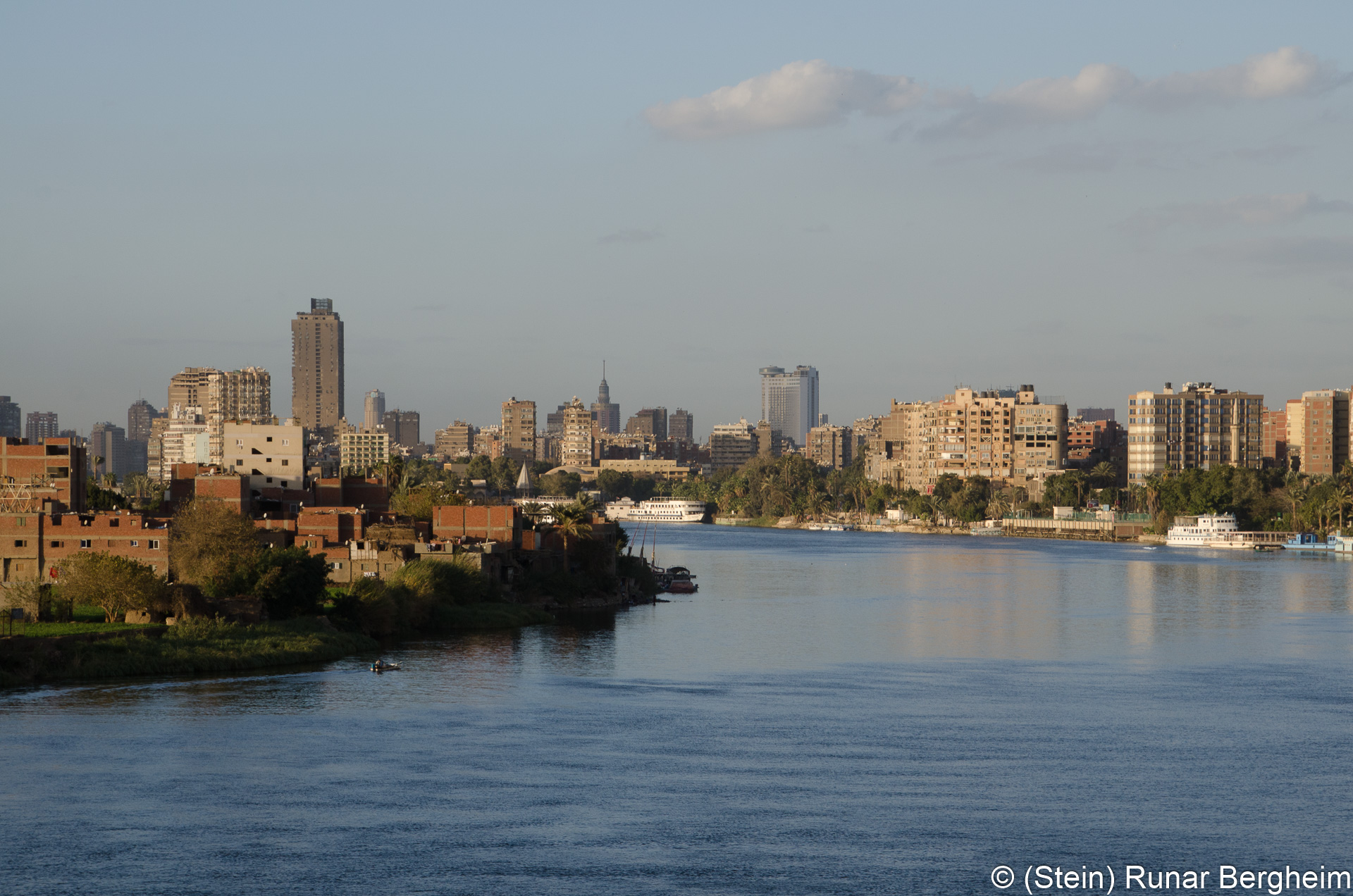
As the car rolled on, we crossed a river. This river was the Nile. In its stately progress toward the Mediterranean, it cuts straight through the metropolitan area of Cairo, separating central, downtown Cairo from Giza on its western bank.
The ancient Greeks, on whose undisputed excellence we lean whenever we heap praise on the worlds democratic institutions, held the firm conviction that the Nile was the only river in the world that flowed from south to north. This opinion, in light of more recent geographical studies, serves as a gentle reminder that just because a civilization is capable of producing a good idea it does not automatically follow that it is incapable of producing a bad one too.
The ancient Greeks held many beliefs, not all of them models for replication. To antagonise just over half of the worlds population, they for an example believed that woman, irrational, emotional and way too susceptible to her physical appetites, ought to limit her ambition to domestic pursuits such as supervising slaves, weaving cloth and producing male heirs onto which familial estates and civic status could be propagated.
The ideal woman, in the words of the historian Thucydides, was she of whom ‘there is least talk among men, whether in praise or blame’. The Greek democracy to which we allude so lovingly was, indeed, participatory, but only for a narrow body of free adult male citizens; women and a host of other, lesser groups were firmly excluded. This, I think, serves as a further reminder that not all aspects of what is broadly considered to be a good idea, need by necessity be good.
In ancient Egypt, things were different. Women, at least those of any societal standing, enjoyed a legal and economic status that was, by the standards of the time bewilderingly enlightened. An Egyptian woman could own, buy, and sell property in her own name. She could initiate divorce and be entitled to a substantial portion of the marital assets. She could bear witness in court, serve on a jury, and enter into legal contracts. In the realm of commerce, she could manage a business, and in religion, she could become a priestess.
Most famously, of course, she could rule as pharaoh, which is why the names of Hatshepsut, Nefertiti and Cleopatra are so well-know to us. That, and the fact that during a period that lasted for more than 3000 years there were no more than a handfull of female pharaohs, lending them the advantage of standing out in history.
Today, the tables have turned somewhat, albeit the Egyptian woman has a strong character and isn’t likely to let herself be subdued by her fellow man.
But I digress.
To return to the Nile, in my minds eye it was a place where simple yet elegant felluccas brandished their pointy sails while the odd dahabiya provided the ideal setting for british gentry and Belgian detectives to in turn commit and solve murder mysteries.
It would all happen on a still-floating river lined by sandy shallows on which lazy crocodiles slumbered in the sun, sheltered by steep river banks and low sandy hills , interrupted only by the odd palm grove or ancient temple.
This is, however, far removed from how the Nile looks on its leg through Cairo.
THE Pyramids
There are pyramids many places in the world
My late countryman Thor Heyerdahl, one of few Norwegians to put his money where his mouth was, did in the later stages of his life see pyramids more or less wherever he looked.
While greater theoreticians and lesser practitioners sought to diminish Mr Heyerdahl’s findings, I do not have the time of day for their opposition. While some of Heyerdahl’s discoveries may have had an element of wishfulness to them, there is little reason to doubt that the architectural principle of the pyramid was widespread.
Still, there is only one place in the world that is recognized merely as THE pyramids. Any other pyramids will need to qualify themselves by the addition of a geographical name or some similar denomination.
The smallholder spirit of my ancestors dated back some 800 years. The unyielding certainty that winter, a failed harvest or some other calamity at any time could strike, had implanted in my lineage a tendency to save wherever saving was possible. I had therefore booked a hotel whose price, star rating and review score were all three in the very lowest end of their ranges.
The hotel was, by the look of it, a new building. So new, in fact, that I suspected parts of it still to be under construction. It also seemed as if its owners ancestors may have had much in common with my own. Every expense had been spared, every corner cut. This included the lack of an elevator. which at first earshot makes me sound entitled and lazy, but that is because I haven’t told you how many floors the hotel had or what sort of luggage I was travelling with.
So, there you have it for making rash judgments.
As it happened, I was upgraded to a penthouse. Not a big, intuitive, easy to recognize penthouse, but a penthouse that with a stretch of the imagination was entitled to the classification on the strength of sitting on top of the building. Its size suggested that it may not have been intended for human habitation, a bag of cement in a corner further suggested that whatever the intent, renting it out had been a premature decision.
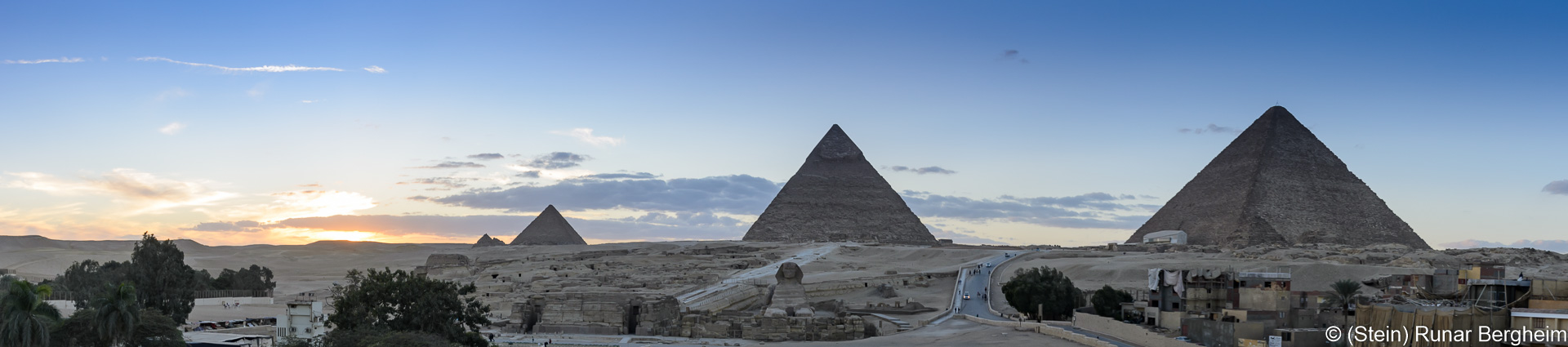
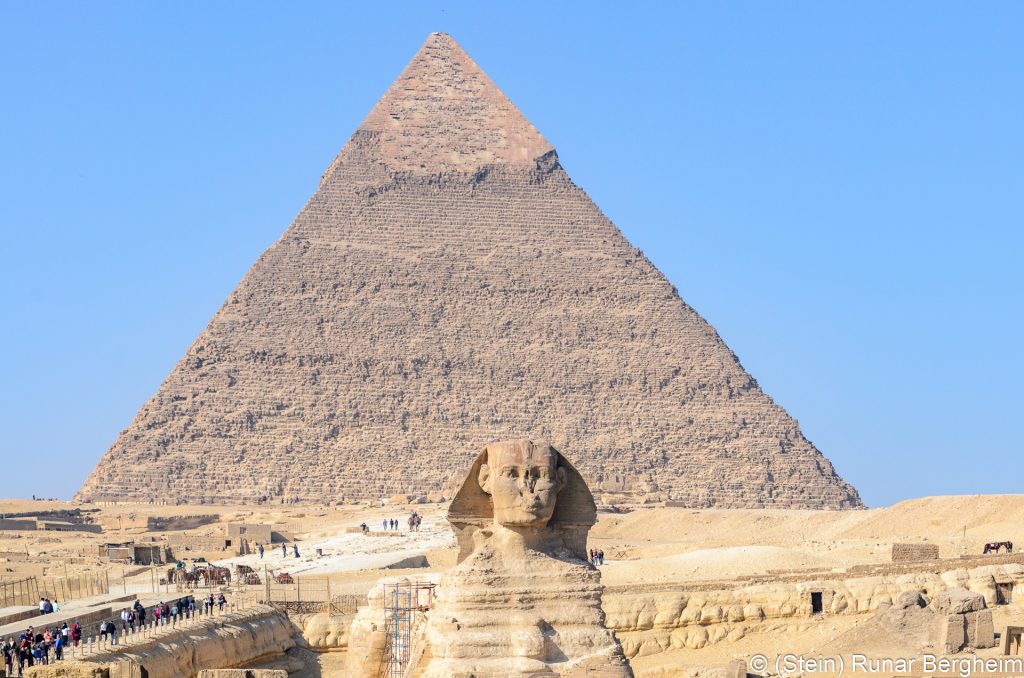
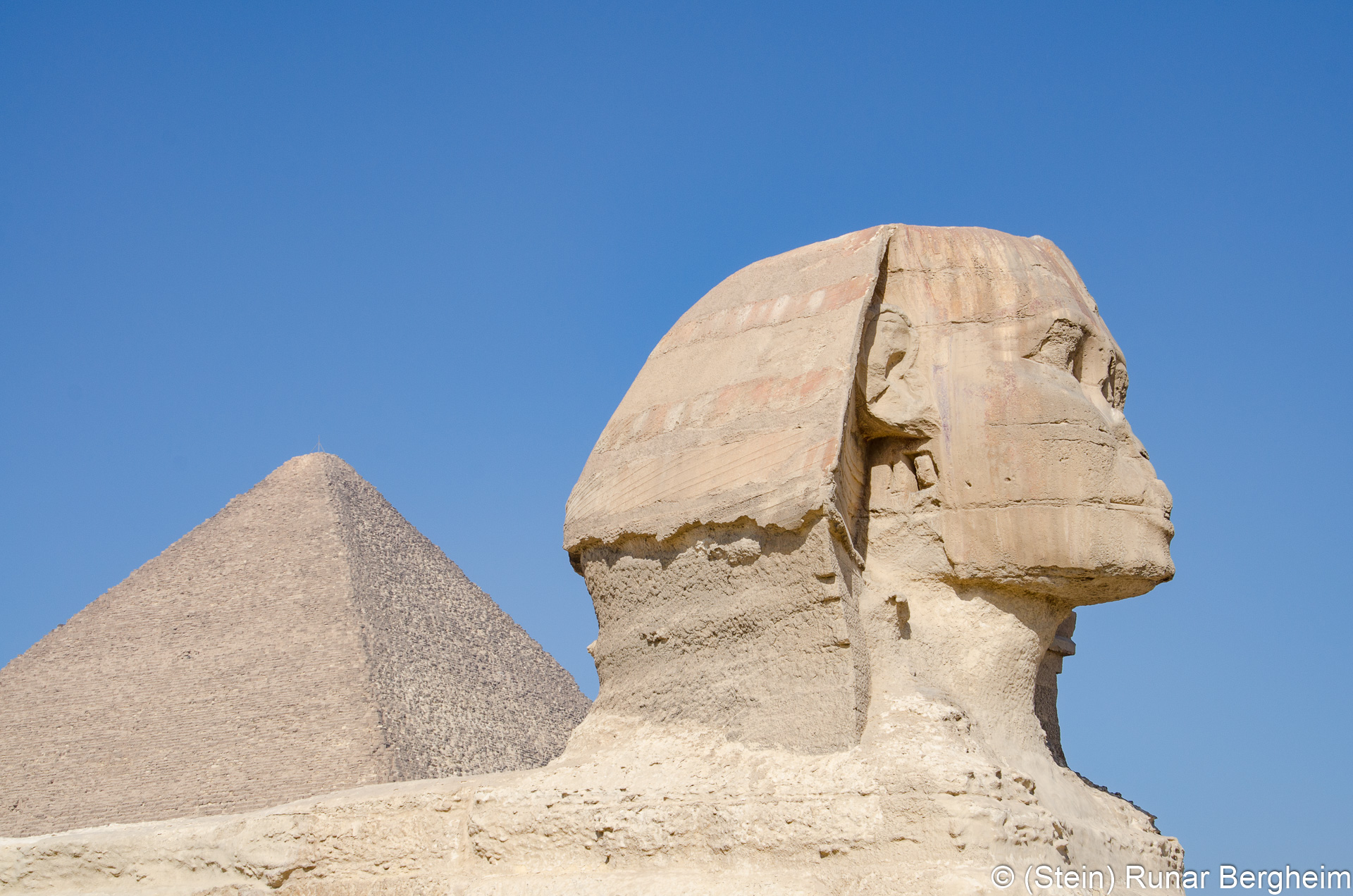
Still, drawing the curtains on a Giza sky that now was showing clear signs of the approaching dawn, to my considerable surprise, revealed an indisputable first class view of the real deal. There, just in front of me, the Sphinx rested at the at the foot of a hill crested by three majestic pyramids and some smaller rubble off to the left.
I was elated by this surprise – but not sufficiently so as to counteract my body’s demand for rest, and I resigned to my bed for what little remained of the night.
Going in
Breakfast was served on the roof terrace with an abandon for weather that signaled an absolute and unshakable conviction that precipitation of any kind would be an impossibility. This would not impress any desert-dweller, but to someone like me, from Western Norway where we endure more than 300 days of annual rainfall, it seemed like an overt display of optimism.
Breakfast was north-African style with freshly baked bread, honey. orange juice and piping hot, slightly muddy coffee .
It was a clear day, as far as cloud cover was concerned, but on the Giza side, the sky was hazy for reasons that I suspected of being connected to desert dust being whipped up in the air. On the Cairo side, pollution lay like a heavy lid on the city.
The Pyramids are one of the wonders of the ancient world. The sheer volume of commerce near the entrance to the Necropolis of Giza where the Pyramids are located, could well be a wonder of the modern one.
It was impressive more for its eagerness and tenacity than it was for its efficiency, and consisted of three consecutive waves of attack on any prospective visitor.
The first onslaught consisted of souvenir sellers whose main hope of income by necessity had to be from people leaving the park. They did, however, show no sign of discriminating against those entering. Souvenirs of any description were available here with no geographical or topical relationship to the pyramids, except, perhaps, for them all having been manufactured by indentured labor.
After the souvenir sellers came the guides.
Against all evidence to the contrary, each prospective guide told me that it was a very poor experience and irresponsible, verging on the extreme, to try and see the pyramids, lest I do it in his company.
He shed doubt whether I would in fact even see all the pyramids without his aid – and pointed helpfully to the greatest pyramid, as if to illustrate his point. He was not an altruistic man, though, and he made it clear that he alone, among his brethren, would be a safe companion for me.
The others, he said, were all people of low morals who would be sure to feed me lies and render my visit to the great pyramids a lifetime disappointment that only years of therapy could help me contend with..
With unparallelled difficulty, I succeeded in shaking off the guides, too.
The final wave consisted of the transport providers. They also aspired to guide me, but from the vantage point of a camel back.
I exchanged many an anxious glance with camels whose owners’ enthusiasm for my custom by far exceeded that of their animals. I could see the grateful look in the camels’ eyes as I politely, but firmly, turned down one offer after another.
Eventually, all attempts at getting at my purse subsided. It was understood that I was a poor prospect and of but little economic significance, and attentions were directed to more promising victims.
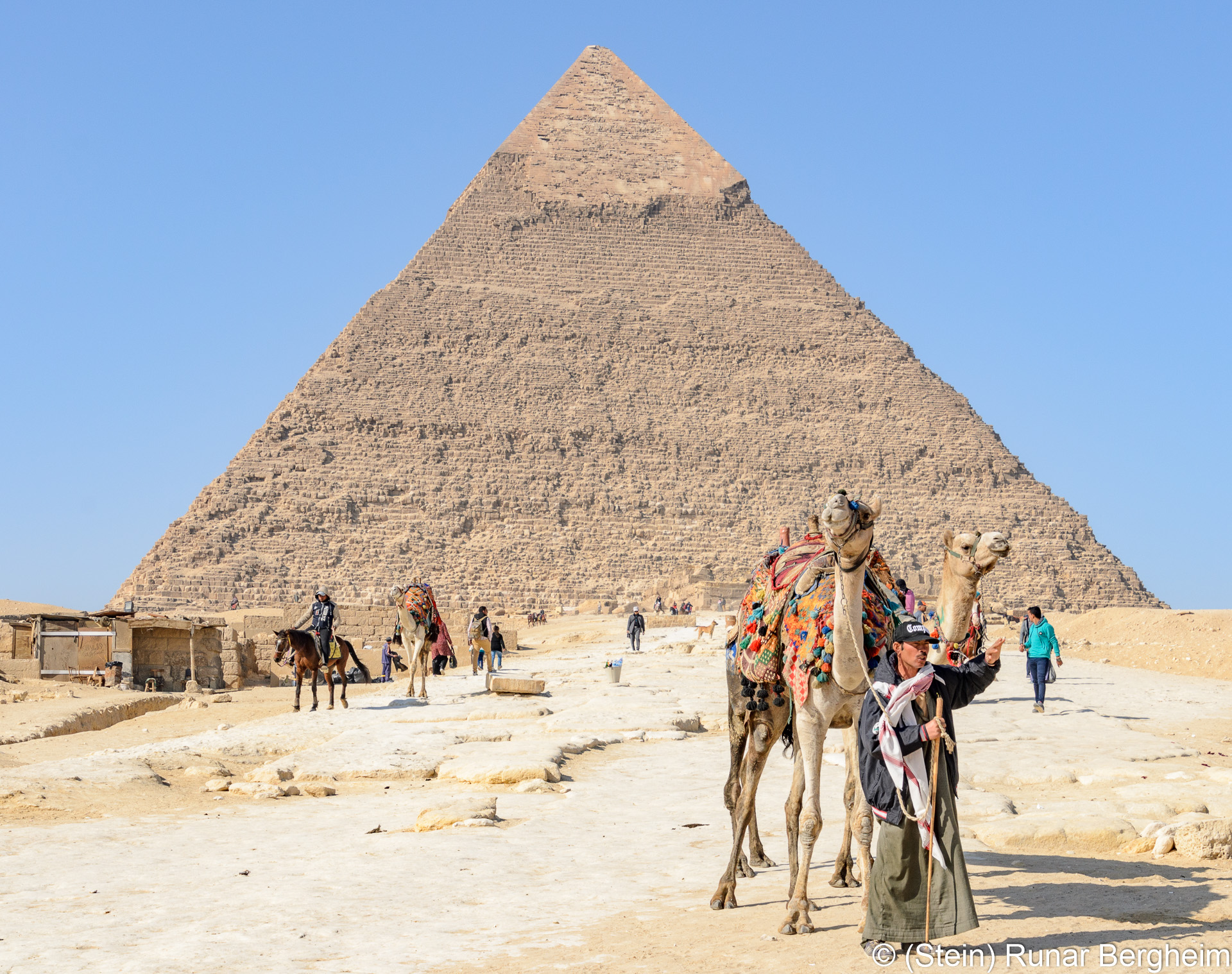
The views were truly splendid and the scale of the pyramids defied expectation and belief.
It was possible for a limited number of people to go inside the Great Pyramid and I had, at some expense, procured a slip of paper that entitled me to this privilege.
I had spent time in underground structures before. Namely in the 15-storey underground dwellings in Cappadocia in Turkey. There I had learned that while I wasn’t suffering from full-blown claustrophobia, I could feel the presence of a thing with much the same shape and size within the confines of my generously sized belly.
I did, therefore, not spend much time inside. A glimpse of the tunnel was enough before I backed out again. The interior of the pyramid was better for the short than the long; it was better for the narrow than the wide; and it was altogether unsuitable for such as who answered to both those descriptions. On the balance, I dismissed the interior of the pyramid as being better for the dead than for the living
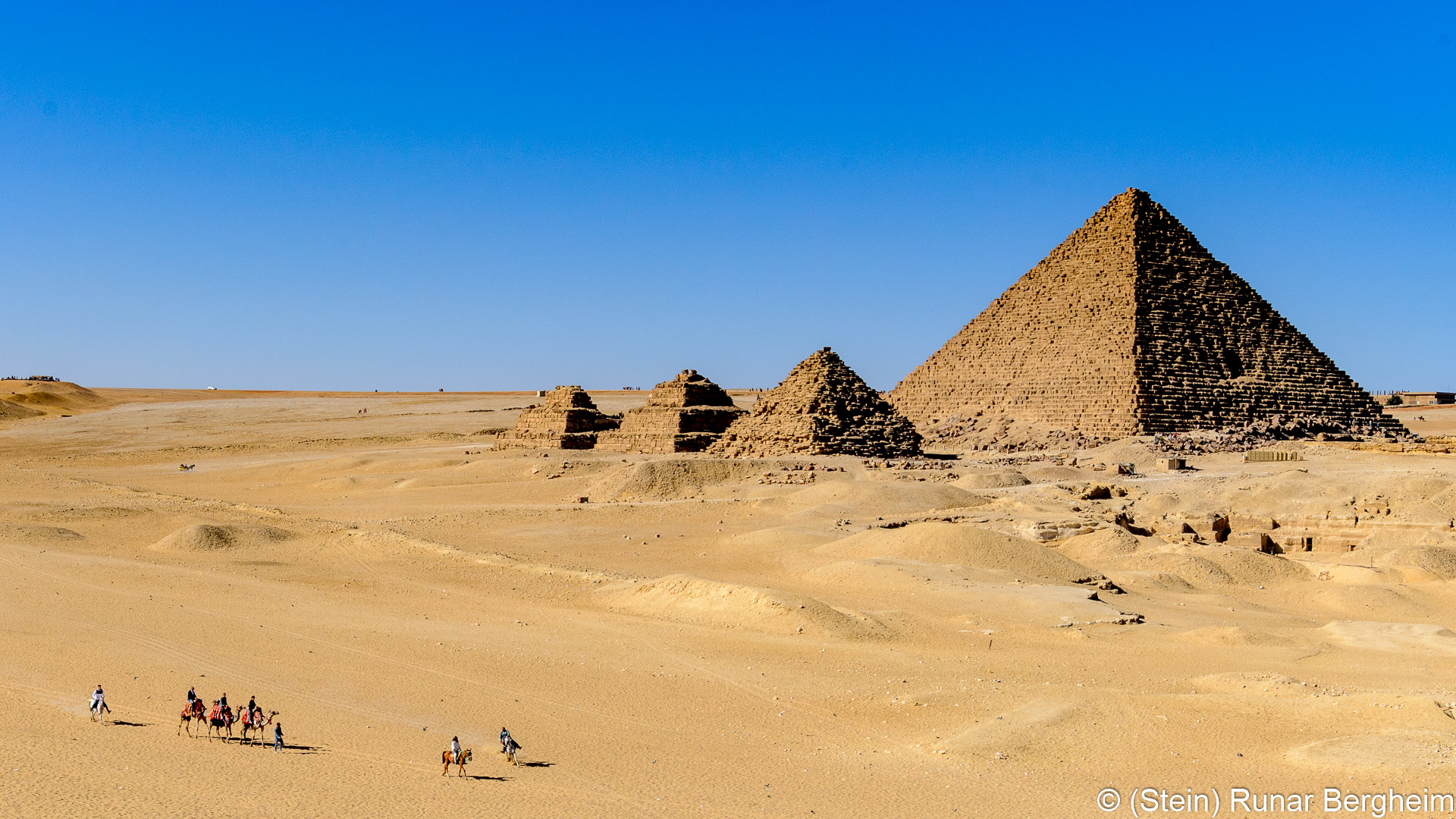
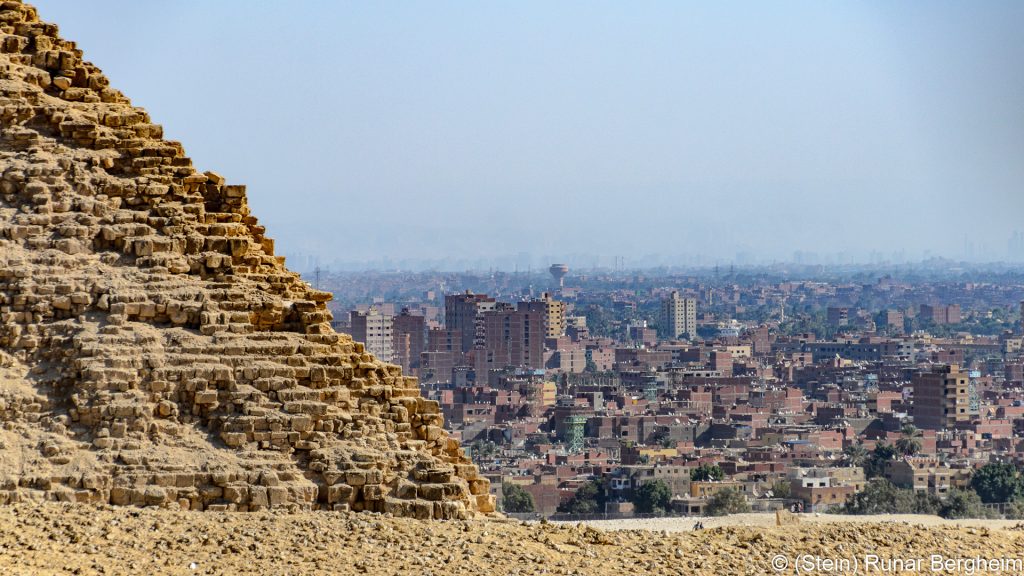
The pyramids sit on the edge of the Giza plateau, and behind them, that is to say to the west of them, the land flattens to a gentle slope. I rounded the great pyramid and walked around the site. I enjoyed the unusual feeling of being very very small, the more familiar feeling of being steeped in history, and, crucially, the comfortable feeling of being in the shadow of each and every one of the pyramids, the sun now performing at the top of its game.
While there must by necessity have been at least one British archaeologist who had contemplated moving a pyramid back to England, it was easy to see why he had settled on robbing Egypt of all its movable property instead.
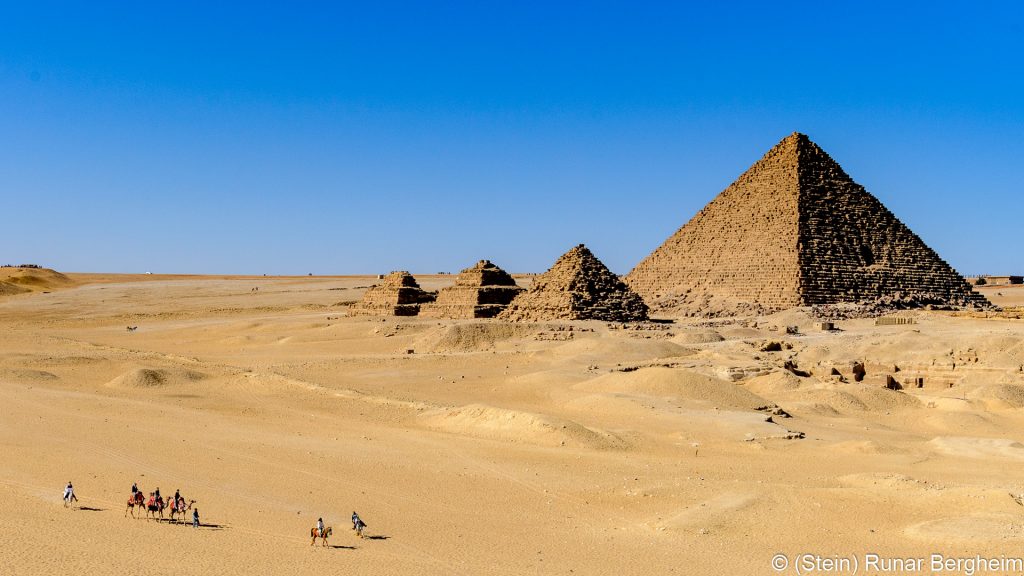
The smaller pyramids were called the Queens pyramids, implying that while woman may well have had her rights, they were nonetheless relative to that of man proper, whose rights were ‘righter’ still.
On the southern fringe of the site, a valley in the sand is lined by a tall dune that provides an excellent vantage point for looking back at the pyramids and it was here that I now headed to see if I could put my camera to work. That done, I was satisfied that I had seen the pyramids and resolved to brave the assaulting forces of market economy again, in retreating to my hotel.
Evening lights
I knew but little of history, but almost everything there was to know about about James Bond. For that reason, I knew that the Pyramids were not only a diurnal attraction but also a nocturnal one.
Jaws had ventured in here during a nighttime spectacle on the heels of some sinister-looking, double-dealing little Egyptian, and had emerged alone, wiping his mouth on his sleeve for theatrical effect.
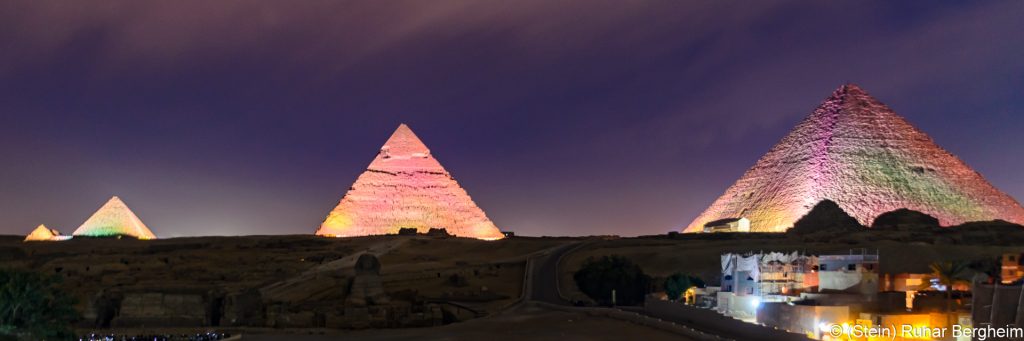
My research had indicated that at least part of this spectacle took place every night; a sound and light show using the pyramids themselves as canvas for projection.
My hotel, which I shall not name lest I be accused of advertising, possessed a roof terrace, and it was from that, firmly seated on a plastic chair that despaired under my weight, that I planned to take in that nights’ spectacular light show.
I had, by this time, reconciled myself to most of the hotel’s many eccentricities, one of which was that while the hotel itself was short of nearly every imaginable comfort and amenity, the staff was all eager to set off on errands to procure stuff from the neighborhood — in exchange for a modest overhead. I had a young man in the hotels service procure me a water pipe, something that he reappeared with so quickly that I was outright startled.
As I puffed on my water pipe, cherishing its gurgling response, the show began with a great crackle from a hidden loudspeaker, followed by a voice of godlike resonance and portentous slowness. It narrated, in a tone of profound and unshakable certainty, the history of the pharaohs, while colored lights played across the stone faces of the pyramids.
The Sphinx was bathed in a lurid purple, then an anxious green, while the voice boomed on about cosmic alignments and eternal legacies. It was, in its way, magnificent. While I sat there puffing smoke, I thought that the ancients, for all their obsession with the afterlife, could never have imagined that their final resting places would one day serve as a backdrop for such a garish and vulgar display.
Still, the pyramids, having endured millennia of plunder, as well as several conquests, would doubtless endure this too – I took a final, meditative pull on my water pipe, and concluded that my further thoughts, while many, did not add anything of value to the scene in front of me.
This text was written following a trip to Cairo in January 2019, only to be laid to rest for seven long years, before being rediscovered in my extensive collection of drafts.
Leave a Reply