river

  • Feudal in the 21st Century

    Feudal in the 21st Century

    The ‘castle’ is a prominent feature of the Belgian countryside, albeit perhaps more appropriately described as cultural rather than natural.

    It is a sad thing about democracies that their buildings do so little to lift the human spirit. Intuitive beauty, the sort of beauty that doesn’t need to be explained to be recognised, is more commonly associated with more malignant forms of government.

    Now, the Kingdom of Belgium is governed in as benign a way as any constitutional monarchy can be. But, like the British, and unlike the Norwegian, Belgians still maintains a sizeable nobility of some 1300 families.

    Rather pleasingly, it is possible, for people suffering from delusions of grandeur, to request a title of nobility by written application to the King. Though, unless applicants have any notable accomplishment to their name, or in some way or other have made themselves useful to the Kingdom, chances of getting one are slim.

    Still, a pathway is a pathway—and hope is the last to die.

    Though devoid of privilege these days, one still expects certain things from one’s nobility, including, but not limited to, an ancestral castle.

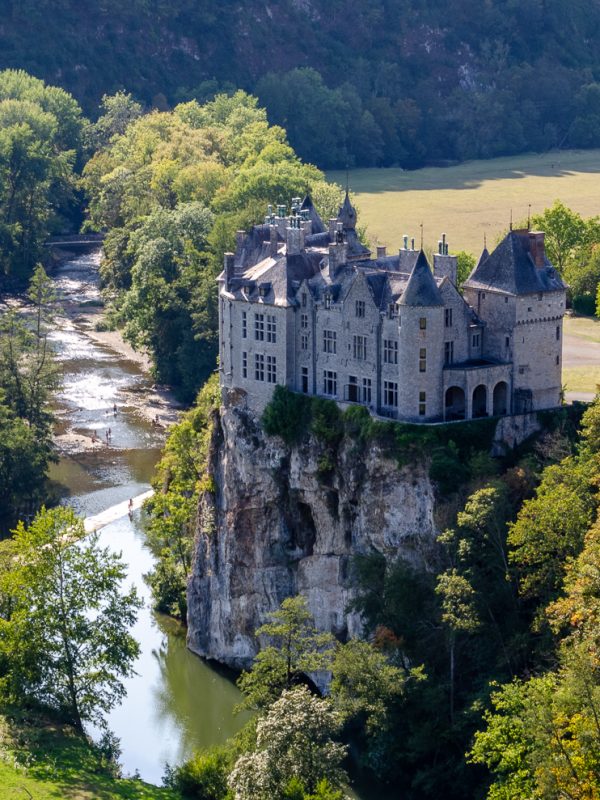
    Chateau de Walzin seen from the hill to the south-east

    While immensely beautiful, castles are also wildly impractical; something as simple as heating might easily lead to financial ruin. And, neither freezing nor bankruptcy would summon much sympathy amongst the general populace.

    Norway abolished most things to do with nobility and stopped conferring new titles in 1821. The country has pursued a line of strict egalitarianism ever since. This has led Norwegians to hold deeply suspicious beliefs on inherited privilege.

    On paper, there are indeed a few noble families left, even in Norway. But, should any of them suggest that they be addressed by their proper titles, they would instantly become a national laughingstock.

    My favourite Belgian castle is the Chateau de Walzin, set on a cliff above the Lesse river, south of Dinant.

    Despite my Norwegianness, I am a guest in Belgium, and most grateful to the House of Limburg-Stirum for maintaining this exceptional piece of heritage. And, also for not setting loose their dogs on impudent Norwegians who roam in nearby forests.

  • The ‘mountains’ of Belgium

    The ‘mountains’ of Belgium

    I have claimed in the past that Belgium doesn’t have any mountains. That is true, objectively speaking, but not necessarily if you ask a Belgian.

    French-speaking Belgians indiscriminately include ‘mont’ as either prefix or suffix to the name of places that decidedly are flat. The Flemish are equally liberal in their use of ‘daal’ and ‘berg’ about places where not even water would be able to tell which way to flow.

    My epiphany came in the realization that a decent valley can exist without a proper mountain. And it has been in this realization that I have found the most rewarding, pleasing, and unexpected vistas of Belgium.

    For a man sufficiently starved on mountains, a hill can be a persuasive surrogate. And, it must be admitted Belgium excels in hills.

    The most gratifying hills I have come across, thus far, are those at Le Herou in Parc Naturel des Deux Ourthes.

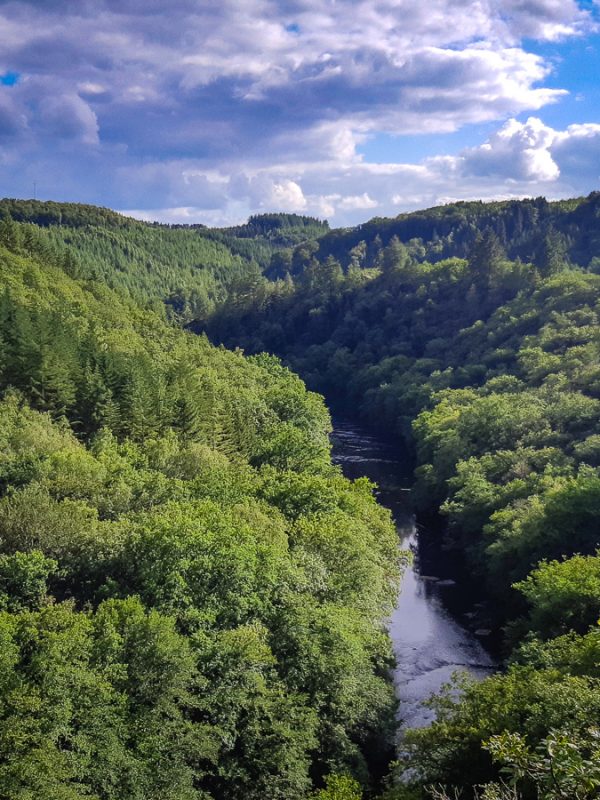
    The Ourthe seen from the Herou site

    Here, a path takes you along a long, winding, and at times steep ridge that sits between two meandering loops of the Ourthe river. At the several outcrops, deeply pleasing views of the river-valley below can be had.

    These views were balm to my soul and instrumental to my mental health this past summer. If nothing else good came of the pandemic, at least it encouraged me to explore natural Belgium. For that, I am grateful.

    As today is the 24th of December, I would like to wish everyone who has read this a very Merry Christmas and thank you for sharing in my slow-moving, narrow-gauge train of thought.